
New Law Changes the Tourism Property Market: Advantages of Buying at Petram Resort
As of 1 January 2026, Croatia has a new Physical Planning Act introducing significant changes to spatial planning and development, particularly affecting tourism zones and future tourism projects. One of the provisions attracting the greatest interest is Article 68, which governs the subdivision of hospitality and tourism buildings intended for accommodation into separate ownership units.
The new provisions were quickly associated in public discussion with phrases such as a “ban on subdivision into separate ownership units in tourism zones”, raising questions among investors and property buyers. International buyers considering Croatia for a second home, a tourism investment or long-term asset diversification naturally want to know what the rules mean for existing resort projects and whether the same restrictions apply to properties that have already been built.
The answer cannot be reduced to the simple claim that the “sale of villas and apartments in tourism zones is prohibited”. The new Act primarily changes the rules for projects planned and developed under the new regulatory framework. Transitional provisions also address projects and tourism zones whose spatial-planning procedures began before the Act entered into force.
This distinction is also important when considering Petram. Petram Resort has already been built and is operational, and its use permit was issued before the new Act entered into force on 1 January 2026. Petram is therefore not a project just entering planning, obtaining key permits or construction under the new rules.
Information about new restrictions on future tourism projects cannot automatically be applied to a completed project such as Petram. For prospective buyers, this is one of the most important distinctions to understand.

What is the new Physical Planning Act?
The new Physical Planning Act was published in the Official Gazette, No. 155/2025, adopted on 15 December 2025 and entered into force on 1 January 2026. It forms part of a broader reform of spatial planning and construction, which also includes a new Construction Act.
The changes cover various aspects of planning and land use. For the tourism property market, a clearer distinction between tourism use and residential use is particularly important.
One reason for the new rules is the need for better land management and to limit uncontrolled conversion into apartment developments, especially along the coast. Over recent decades, Croatia has seen intensive tourism construction. In some cases, land intended for tourism has gradually taken on the characteristics of conventional residential development.
Building numerous apartments on tourism-designated land, dividing them into separate units and selling them individually can gradually change the character of an entire zone. Instead of a functioning tourism resort, the result may be a collection of separate properties that no longer operate as part of one integrated tourism system.
For this reason, the 2026 Physical Planning Act introduces stricter rules for new tourism projects and clearer conditions under which individual villas and apartments may form part of a tourism resort.
Buyers should understand the difference between a tourism residence within an organised resort and a conventional apartment used solely as a home. The new Act reinforces this distinction.
A key issue is the subdivision of tourism properties into separate ownership units. This is not merely a technical division of a building; it is a legal process through which parts of a building become separate units of use and ownership. It therefore has a significant impact on how tourism projects can be developed and commercialised.
What does Article 68 of the new Act provide?
Article 68 establishes a clear general rule: hospitality and tourism buildings intended for accommodation may not be subdivided into separate ownership units.
At first glance, this may appear to be a complete ban on selling individual villas and apartments in tourism resorts. However, the Act provides an exception that is central to understanding the new tourism-development model.
Subdivision is permitted for high-category hospitality and tourism buildings—five-star properties—provided that at least 70% of accommodation capacity is hotel accommodation. The remaining maximum of 30% may, subject to other statutory conditions, be subdivided into villas and apartments.
Timing also matters. A use permit must first have been issued for the hotel and accompanying facilities within the area covered by the location permit.
This creates a clear distinction between a tourism project primarily designed as a hotel resort with a smaller residential component and one based almost entirely on the sale of individual apartments or villas from the outset.
The new model therefore does not rule out ownership of tourism residences, but links it to the operation of the resort as a whole.
In other words, it is not enough to build a villa or apartment and sell it as a standalone property. Where the model permitted by Article 68 is used, individual units must remain part of a wider tourism entity.
This is one of the key changes introduced by the 2026 Physical Planning Act.
A villa or apartment in a resort is no longer the same as a conventional residential property
Article 68 sets out further conditions that clarify the legislator’s objective.
Subdivided villas and apartments must function as a single operational unit with the hotel. A centralised model for management, maintenance and rental is envisaged, and owners must entrust the management of their units to a common operator for the provision of hospitality and tourism services.
An individual property therefore does not exist entirely separately from the resort. Its tourism function is linked to the organisation of the overall project. Owners must contribute to resort maintenance costs, while the common operator also has a right of first refusal. The Act also expressly states that villas and apartments are not intended for residential use.
Another provision is particularly relevant to prospective buyers: an owner may use their unit for personal purposes for no more than 60 days in a calendar year. This further confirms that these units are not treated as conventional homes; their primary function is tourism. Article 68 also prohibits subdivision on maritime public domain and provides that contracts concluded contrary to the statutory rules are null and void.
Investors should therefore understand that the new system not only restricts subdivision but also establishes precise rules for cases in which subdivided villas and apartments may still be included in a tourism project.
The logic is clear: a tourism residence should remain part of the resort rather than become an ordinary residential unit completely detached from the rest of the project.
Under the new rules, subdivision in a tourism zone must therefore be considered in conjunction with the hotel, management, maintenance, rental and tourism function of the entire complex.
Who is affected by the new rules?
The most immediate impact will be felt by investors just starting to develop tourism projects. For a project now being planned in a tourism zone, it is no longer sufficient to consider only the attractiveness of the location, market demand or the potential to sell individual units. From the outset, developers must consider the property’s category, the ratio of hotel to residential capacity, the management model and all statutory conditions for possible subdivision.
This is particularly relevant to projects positioned as branded residences or similar concepts, where villas and apartments are sold to individual buyers while the hotel or resort function is intended to remain in place.
If a project is not structured to meet the new Act’s requirements, the possibility of individual sales and subdivision cannot be taken for granted.
For new projects, this may mean more complex planning, stricter conditions and a greater need to coordinate all elements of the resort before implementation begins.
The implications can also be considered at market level. If stricter requirements limit the development of new resort villas and apartments, the future supply of such properties may become more selective. This raises another question: what happens to projects that have already been built? This is where Petram Resort becomes relevant.
Why does Article 68 not apply to Petram?
The key fact for prospective buyers is that Petram Resort is not a new project being planned under the 2026 rules.
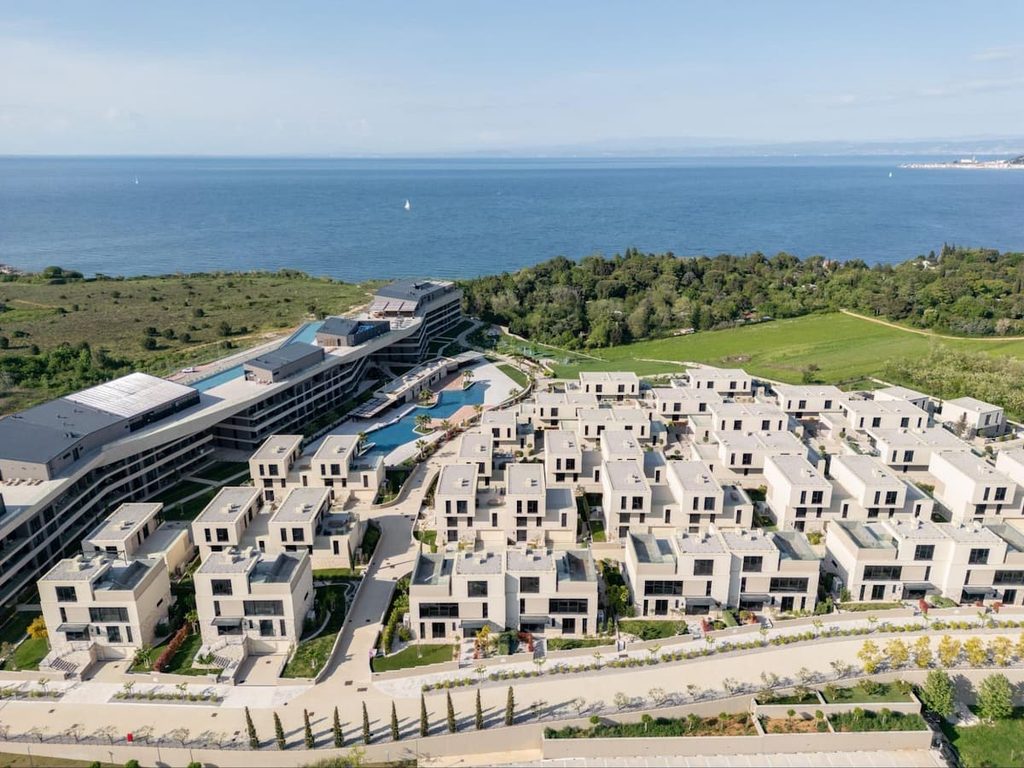
Petram Resort in Savudrija has already been built and is operational. It has passed through planning, development and construction, and its use permit was issued before the new Act entered into force on 1 January 2026. Petram should therefore not be treated in the same way as a project only now beginning the development of a tourism zone.
It is important to distinguish between two situations.
In the first, an investor buys land today or develops a new tourism project and must comply with the rules effective from 1 January 2026.
In the second, there is an already built resort such as Petram, whose project and permitting framework was established before the new Act entered into force.
The new Act also contains transitional provisions for tourism buildings and tourism zones where certain spatial-planning steps had already been taken before it entered into force. Specifically, Article 243(3) provides for the possibility of subdivision under the previous rules for certain tourism buildings for which a location permit had already been issued or applied for, and for tourism zones where preparation or amendment of a detailed development plan (UPU) had already been adopted or initiated.
This is an important transitional safeguard for projects that did not originate after 1 January 2026 but began establishing their planning status under the previous legislative framework.
In Petram’s case, it is additionally important that the resort has already been built and holds a use permit issued before the new Act entered into force.
Article 68 therefore cannot simply be interpreted as a new prohibition that retroactively changes the status of a resort that has already been completed.

For a prospective buyer, this is the key distinction: Petram is not a project that still needs permits, buildings or proof that it can operate as a resort. Petram is already an existing resort.
What does this mean for property buyers at Petram Resort?
For buyers, what lies behind the legal terminology may be the most important point. Buying a property in an already built resort is materially different from investing in a project that exists only on paper.
With a new project, buyers often make decisions based on a future vision. The location may be attractive, the architecture appealing and the plans ambitious, but many steps remain between signing an agreement and final delivery. Permits must be obtained, buildings constructed, infrastructure and facilities delivered, and the project completed in line with the intended concept.
Each stage carries a degree of uncertainty. The situation at Petram is different.
The resort has already been built, exists on the ground and is operating. Prospective buyers do not need to imagine what the project might look like when completed; they can see the actual architecture, surroundings and location.
This is particularly significant as the regulatory framework for new tourism projects changes. If future projects must meet stricter requirements for subdividing and selling villas and apartments, the supply of completed properties in well-organised resorts may become more selective. For investors, the value of an existing project lies not only in being “finished”, but also in having passed through development stages that new projects will still have to complete.
Investing in a completed property allows buyers to make a decision based on reality rather than future projections alone. The location is known, the resort is built and the surroundings are visible. Architecture and construction quality can be assessed, and existing facilities can be experienced. Buyers do not have to rely exclusively on renderings, floor plans and promises about future development.
This does not mean that every completed property is automatically a good investment. As with any property purchase, ownership documentation, legal status, conditions of use, the management model and all other factors relevant to the specific unit should be checked.
Nevertheless, the difference between a completed resort and a project still under development remains important. At Petram, buyers enter an existing tourism entity. This is particularly relevant to those who see a property not only as a place for occasional stays but as part of a broader investment strategy. Location, construction quality, project sustainability, tourism context and the long-term limits on supply all matter.
The 2026 Physical Planning Act demonstrates how important it is to understand the broader regulatory framework before making an investment decision.
Rules are now stricter for new projects. For completed projects, their existing legal and development status is crucial. Petram does not still have to become a resort: it is an already built resort in Savudrija. Its value to buyers stems from the fact that it is a completed investment entity, not merely a future project.